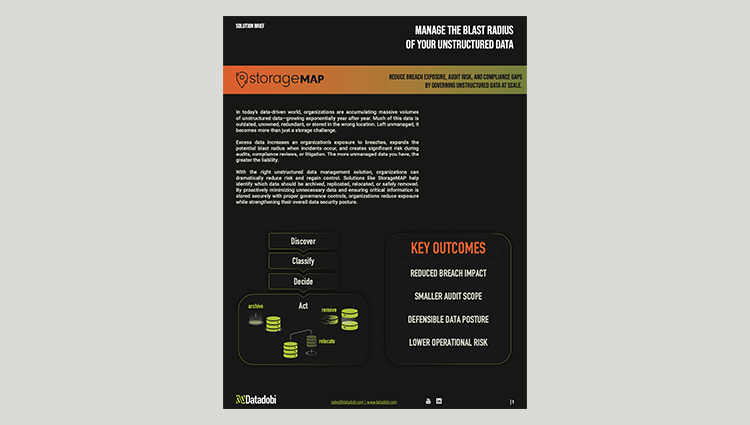
Shrink Your Unstructured Data Blast Radius

StorageMAP helps strengthen data security posture management by finding sensitive data exposure, reducing risky data sprawl, and improving unstructured data security.

Why StorageMAP

Find Risk Before It Spreads

Unstructured data security is difficult when high-risk files are scattered, stale, over-retained, or stored in the wrong places. StorageMAP helps organizations expose risky data conditions, reduce unnecessary access and storage exposure, and produce the reporting needed to support data security posture management (DSPM), audits, and legal readiness.

Exposure With Context

Enhance DSPM outcomes with clearer visibility into risky data, stronger placement decisions, reduced blast radius, and governance evidence.

of enterprise data is dark data. Organizations often don’t know what sensitive data they have.

annual growth in unstructured data. Exposure risk increases faster than manual governance can keep up.

Manage Exposure Before Impact

StorageMAP helps security, governance, legal, and IT teams understand where unstructured data creates risk—and what to do about it.

Risk Visibility

Find Risky Data

Unstructured data often includes outdated, unowned, sensitive, or improperly stored files. StorageMAP helps identify where sensitive data exposure exists so teams can act before it expands breach, audit, or litigation risk.

Exposure Control

Shrink the Blast Radius

Security incidents become more damaging when unnecessary data remains on vulnerable or broadly accessible systems. StorageMAP helps identify data that should be archived, relocated, secured, or removed to reduce exposure.

Governance Proof

Prove Data Stewardship

Data that must remain still needs oversight. StorageMAP supports unstructured data security with reporting that helps prove where retained data lives, how it is governed, and whether policies are being enforced.

See It In Action

DSPM Needs Unstructured Data Context

Improve data security posture management with deeper visibility into sensitive, stale, misplaced, and high-risk unstructured data across complex storage environments.

Data Exposure FAQs

What is data security posture management?

Data security posture management, often called DSPM, helps organizations discover where sensitive data lives, understand how it is exposed, assess risk, and prioritize remediation. For unstructured data, DSPM requires visibility across file, object, on-premises, and hybrid cloud environments where high-risk data can easily spread.

What is sensitive data exposure?

Sensitive data exposure occurs when confidential, regulated, high-value, or business-critical data is stored, retained, accessed, or placed in ways that increase security, compliance, or legal risk. Exposure can come from outdated files, over-permissive access, unmanaged copies, stale data, or sensitive content stored in the wrong environment.

Why is unstructured data security difficult?

Unstructured data grows across shares, archives, object stores, user directories, and hybrid-cloud platforms. Because it is often duplicated, aging, unowned, or poorly classified, organizations struggle to know what data is sensitive, where it resides, who is responsible for it, and whether it should remain accessible.

What is breach blast radius?

Breach blast radius describes the amount of data, systems, users, and business impact that could be affected by a security incident. Reducing blast radius means limiting unnecessary data exposure, improving data placement, removing low-value risk, and ensuring sensitive data receives appropriate governance.

How does StorageMAP support DSPM?

StorageMAP supports DSPM by giving teams visibility into unstructured data risk across heterogeneous storage environments. It helps identify sensitive, stale, misplaced, or non-compliant data so organizations can make better decisions about what to secure, archive, relocate, retain, or remove.

How can organizations reduce exposure?

Organizations can reduce exposure by identifying high-risk data, minimizing unnecessary copies, archiving or deleting low-value content, moving sensitive data to better-controlled locations, and monitoring whether governance policies are being followed. StorageMAP helps turn these actions into a repeatable data exposure management process.

Need to reduce sensitive data exposure across a large unstructured data estate? Datadobi can help you find risky data, strengthen unstructured data security, and support DSPM with evidence-based governance.


Featured Resources

Explore Datadobi resources on unstructured data security, data exposure management, DSPM support, governance, and risk reduction.