Deep Analytics and Enrichment
Scan, index, and analyze all unstructured data whether file or object in nature. Enrich and organize data with classification tags that can be used in downstream reporting.
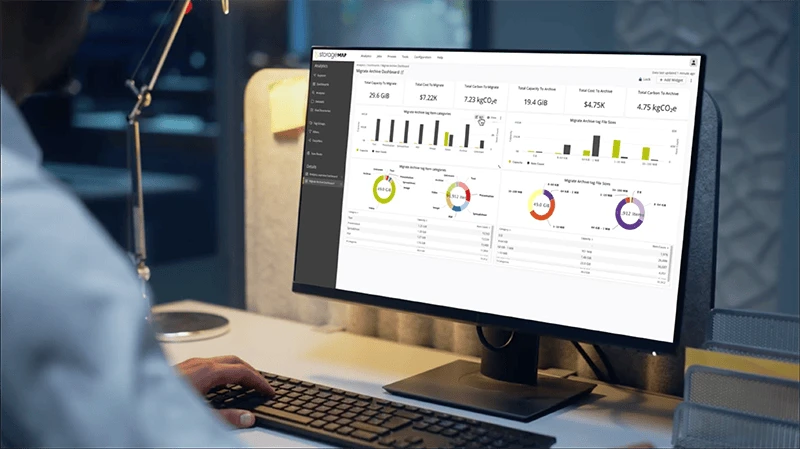


Combine visibility, policy execution, and data mobility in one intelligent platform. StorageMAP is the leading data orchestration solution built for unstructured data management and file analysis across complex, multi-vendor NAS and hybrid‑cloud environments.
Most tools stop at visibility. StorageMAP carries unstructured data from file analysis through policy-driven action—tagging, moving, archiving, and deleting with full traceability. One platform connects discovery, analytics, orchestration, and mobility across entire storage landscapes.
Enterprise data orchestration software must analyze, organize, and act across billions of files while maintaining control, performance, and auditability.
With billions of files growing at 30-50% per year, getting insight into the mounting data is the number 1 task of anyone concerned with unstructured data. StorageMAP brings order to chaos with deep analytics to truly understand the data, dashboards to satisfy every stakeholder role, and industry standard project management tools to deliver real results.
Taking action to achieve quick and measurable results is the aim of any unstructured data project. StorageMAP’s data mobility engine is proven in the world’s largest and most complex environments and is known throughout the industry as the most powerful and comprehensive data mobility platform.
With unstructured data threatening to inundate your organization, you need to rely on expertise to help you navigate the best possible path to dealing with it. Our support teams help you navigate through the maze of your unstructured data projects to focus on what really matters (no bots here).
Explore how data orchestration software, file analysis software, and unstructured data management software come together in one platform. From discovery to execution, StorageMAP connects insight to measurable outcomes.
 Watch Video
With unstructured data threatening to inundate your organization, you need to rely on expertise to help you find the best possible path forward. Our teams help you navigate the maze of your unstructured data to focus on what really matters.
Scan and index unstructured data across file and object environments to expose what actually exists: stale data, duplicates, ownership gaps, and hidden risk. Replace assumptions with a clear, data-driven understanding of your environment.
Go beyond raw file analysis by enriching data with classification tags and metadata. Organize unstructured data into something usable, ready for reporting, governance decisions, and downstream policy execution.
Dashboards translate complex storage environments into clear metrics and trends. Monitor key indicators across capacity, activity, and risk to give technical teams and leadership a detailed, accurate view of the data landscape.
Policies establish how unstructured data should be handled throughout its lifecycle, from tagging and placement to retention and deletion. Create consistent, repeatable rules that align data decisions with business priorities.
Automation turns defined policies into action. When thresholds are met, workflows trigger without manual intervention—ensuring consistent execution across massive environments without adding operational overhead.
Migrate, replicate, and transform data across heterogeneous storage systems with precision. Every action is tracked with logging and chain-of-custody, supporting auditability while handling multi-petabyte workloads.
Scan, index, and analyze all unstructured data whether file or object in nature. Enrich and organize data with classification tags that can be used in downstream reporting.
A library of analytics views monitoring and tracking key performance indicators in the environment.
A collection of defined data management workflows that govern the handling of data through its lifecycle.
Implements and executes the workflows defined in policies when triggers or thresholds have been reached or exceeded.
Migrate, Replicate, Move, Copy, and Delete data at scale, quickly, accurately, and with full logging and chain‑of‑custody.
Transforming data from the file format to an object format and vice versa.
StorageMAP operates across heterogeneous storage systems without lock-in or disrupting existing data paths. Its architecture supports scale, interoperability, and long-term flexibility across evolving infrastructure strategies.
Completely vendor-neutral to support the hybrid cloud.
Scalable in capacity, number of files, and number of systems.
Fully interoperable with the nuances of thousands of storage and cloud implementations.
Entirely transparent to the storage environment with no impact on the data path.
Zero lock-in to proprietary data formats with no data transformation.
Automation to easily implement and monitor data management policies.
Dive deeper into data orchestration, file analysis, and unstructured data management with resources focused on architecture, governance, migration, and large-scale execution.
StorageMAP is a data orchestration platform that combines file analysis, policy management, automation, and data mobility for unstructured data across hybrid-cloud storage environments.
Migration tools focus on moving data. StorageMAP offers continuous unstructured data lifecycle management by adding analysis, policy orchestration, automation, and reporting. Migration is one of the actions available with StorageMAP but there is so much power within the platform.
Absolutely. StorageMAP is designed for billion-file and multi-petabyte environments, scaling across capacity, file count, and number of systems without relying on lightweight or manual approaches. It is an enterprise platform built with the complex needs of an enterprise at its core.
Yes. StorageMAP analyzes, manages, and moves both file and object data, including transformations between formats as infrastructure strategies evolve.
StorageMAP supports data mobility across object environments with logging and traceability, making it suitable for governed migrations where auditability and control are required.
The platform provides dashboards and reporting that track data usage, policy outcomes, migration progress, and operational metrics for technical teams, executives, and compliance stakeholders. Learn More
Policies define conditions and actions such as tagging, moving, archiving, or deleting data. StorageMAP executes these workflows automatically when criteria are met.
StorageMAP is purchased as an annual subscription. It includes analytics, dashboards, automation, and core data management actions such as move, delete, report, copy, and tagging. Add-on licenses for migration and replication are purchased separately. Exact final cost is based on a variety of factors that the Datadobi team will discuss during a discovery conversation.
Looking for more than isolated tools? StorageMAP connects file analysis, orchestration, and execution in one platform built for modern unstructured data environments.